Miami Township Previous Residents by Era
A backward search works best when each source is assigned its own task. Start with the address and parcel for a recent question. Use the Recorder for the title trail, then use dated directories, census records, maps, and notices for older household context. The ranges below are verified limits, not a promise that every Miami Township address appears in every source.
| Source | Years it covers | Where held | What it shows |
|---|---|---|---|
| Recorder online documents | 1980-present | CountyFusion | Recorded deeds, mortgages, instruments, and image route |
| Recorder historical records | Before 1980 | Recorder, Batavia | Earlier books, pages, plats, and title-chain material |
| Federal census | Released after 72 years; 1950 currently released | Census, NARA, and genealogy databases | Enumerated household and place snapshot |
| Cincinnati Enquirer archive | 1841-2009 | Clermont Library resource | Notices, obituaries, and address events |
| Sanborn maps | Plans produced 1867-1970 | Ohio Web Library through Clermont | Building and street context, not names |
| Permit records | Retained under schedule | Permit Central | Project chronology if the record remains |
The property chain does not demonstrate continuous occupancy. It identifies recorded transfers and people or entities in document roles. A directory or census can add a dated household clue, while a map can establish that a building or street existed at that time.
Start Miami Township Previous Residents With a Parcel
Use the Clermont County Auditor address search to connect a situs address to its parcel card. Save the current owner as the roll states it, the parcel number, legal description, and transfer reference. A situs address is the physical location. A mailing address is merely where the owner receives correspondence and can be elsewhere.
Next, use County GIS to identify the parcel polygon, road context, and adjacent lots. The GIS publishes parcel, address, roads, township, ZIP, zoning, and precinct layers. Its Search, Identify, Measure, Print, and layer controls help confirm the parcel and legal description before the Recorder search. That Auditor to GIS to Recorder sequence is more reliable than trying to force a modern street number into every old instrument.
The Auditor result itself can also preserve the parcel ID, situs address, owner name as the tax roll states it, mailing address, legal description, land and building attributes, valuation or tax fields, and any transfer reference shown. Label each item by its source and access date. The parcel card supplies property context; it is not a list of every person connected to the address.
Trace Miami Township Previous Residents Through Deeds
The Clermont County Recorder directs a parcel-only researcher to the Auditor first, then to CountyFusion for the instrument index. Search the present owner as a grantee, the party who received the recorded deed. Read the seller, or grantor, on that deed. Search that predecessor grantor as a grantee to find the earlier acquisition, and repeat. At every transfer, compare the legal description, lot, subdivision, plat, and date to avoid attaching a same-name result to the wrong parcel.
- Record the Auditor parcel number, legal description, present owner, and transfer reference.
- Open CountyFusion and accept its disclaimer, then search the present owner as grantee with a document type or date when needed.
- Inspect the purchase deed, preserving the document number, recording date, grantor, and legal description.
- Search that grantor as a prior grantee, then repeat the sequence one deed at a time.
- Use plats and subdivision data where the wording changes, and take a pre-1980 gap to the Recorder rather than guessing.
- Grantor
- The party transferring an interest in a recorded document.
- Grantee
- The party receiving that recorded interest. A later deed may show the same person in the opposite role.
- Chain of title
- The linked sequence of recorded transfers for the same parcel or legal description.
- Legal description
- The lot, block, subdivision, survey, or plat wording that identifies land beyond a changing street address.
A Recorder index result can show indexed party names and roles, document type, recording date, instrument number, book and page where applicable, legal or property description, cross-reference, and an image link where available. Record the item exactly as indexed. Recorded land documents are generally public, but statutory exclusions still apply, including nonpublic veteran DD-214 filings.
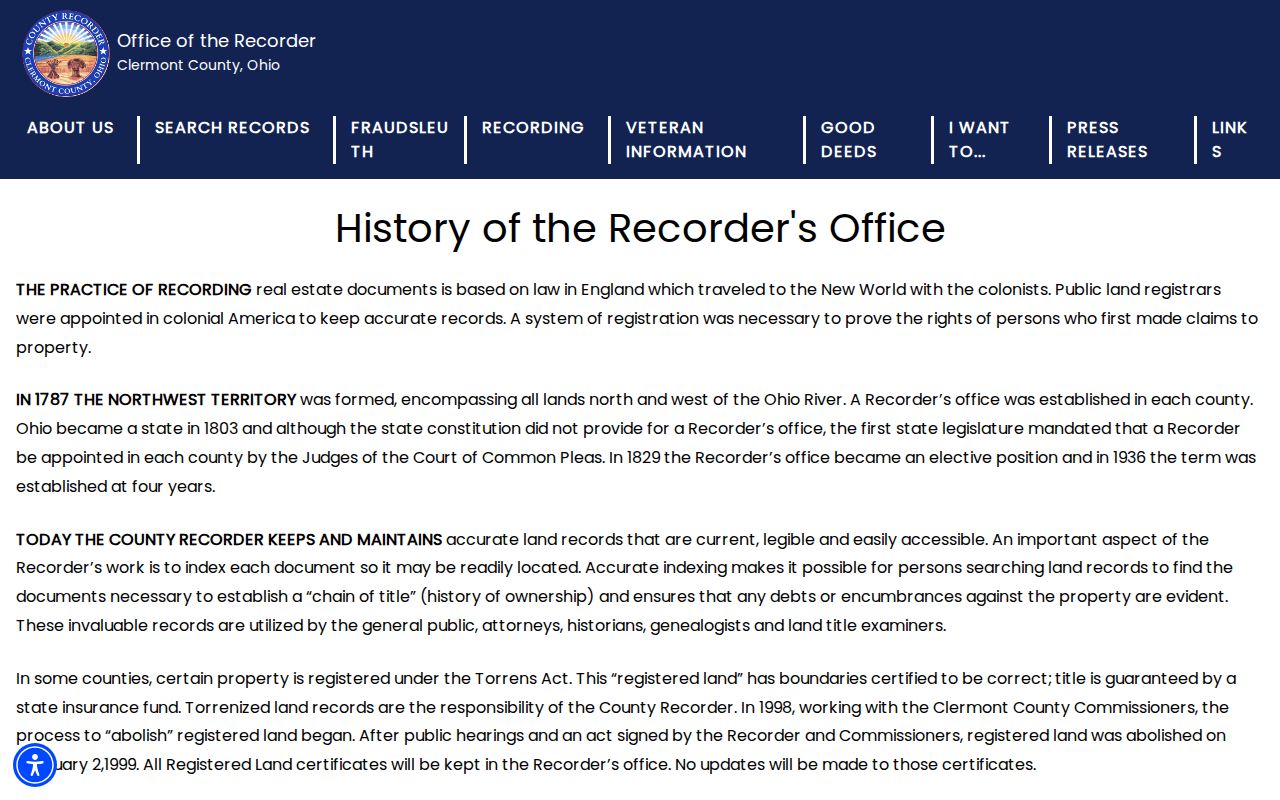
The Recorder’s history of indexing explains its chain-of-title role.
Miami Township’s 1980 Deed Boundary
CountyFusion web copies reach 1980 to the present. Earlier material remains a Recorder task, using the counter, a mail request, or staff-assisted historical books. At the counter, computer-printed copies cost $0.10 per page; a staff-pulled book copy costs $0.25 per page. A mailed written request needs the correct fee and a self-addressed stamped envelope, and mailed copies cost $2 per page. Checks are payable to the Clermont County Treasurer; card use has a 2.5 percent convenience fee or $2 minimum.
CountyFusion’s search inventory includes All Names, recorded-date limits, result filters, document types, instrument number, book-page, and name options such as exact, similar, or surrounding names. Recorder guidance says a broad name search is the most complete approach and recommends entering less of a name for variants. Keep HIST DOCS selected for pre-1993 research when applicable.
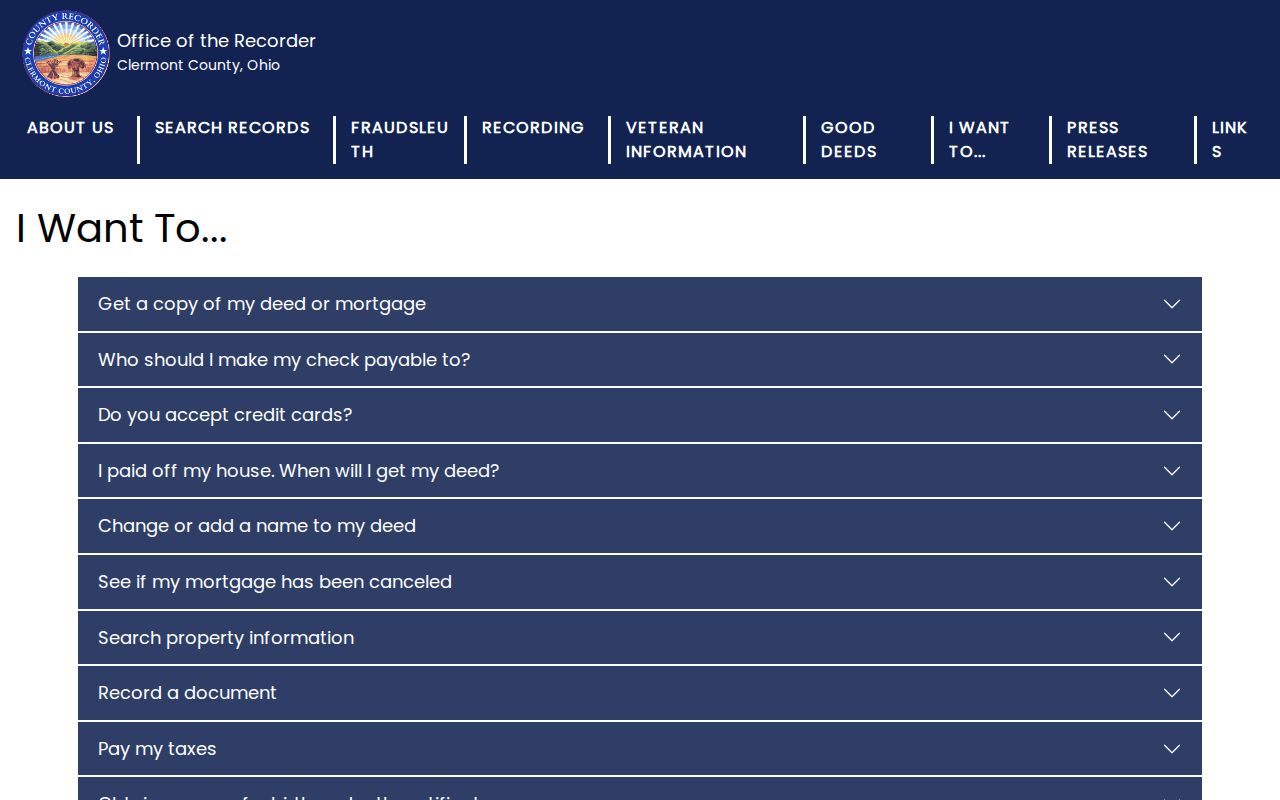
Recorder access guidance confirms the web cutoff and the counter and mail copy choices.
Miami Township Historic Names Break Address Searches
Old land, map, and newspaper records may use O'Bannon Township, O'Bannonville or O'Banionville, Perintown or Perin's Mills, Mulberry or New Salisbury, Branch Hill, or Guinea City. Miami Township began as O'Bannon Township in 1801. Branch Hill was laid out in 102 lots in 1873, while Guinea City’s post-office sequence ended in 1907 when Loveland handled delivery. These are search terms, not automatic matches to a modern address.
When an address goes cold, search the historic name with the surname and inspect the legal description, road, survey, or plat. The Recorder maintains records such as annexations, centerline surveys, street-name changes, and street or alley vacations. Request the actual recorded instrument or map when address continuity is in doubt.
Pair Miami Township Past Residents With Census
Ownership is only one layer of a Miami Township past-residents search. After a deed supplies a time window, search the library catalog for city, telephone, or criss-cross directories by address and surname. Pair any directory year with the nearest released federal census, currently 1950, and use the Cincinnati Enquirer archive for notices that can explain a change. The Miami Township city-directory collections hold the documented directory titles and the rules for inspecting an entry.
Use this simple flow: deed date and legal description → catalog result or staff request → dated directory line → nearest released census → newspaper notice or obituary → Recorder or Probate record if a family event needs verification. A person absent from a directory may have moved, been unlisted, appeared under a variant name, or fallen outside a volume’s locality coverage.
Lawful use. Miami Township previous-resident research fits house history, family history, estate context, and personal curiosity. Do not use a dated record to stalk, harass, or track any living person.
Miami Township Maps and Notices Add Context
Sanborn Fire Insurance Maps, produced from 1867 through 1970, can show a building footprint, street pattern, and development context before a household search begins. They do not list every person. The Clermont Library genealogy route also provides the Cincinnati Enquirer archive from 1841 through 2009, with full-page and article images and home access for library-card holders. Notices and obituaries can date a marriage, death, reunion, business, or address event.
Use the Batavia genealogy collection when the catalog identifies a likely directory, map, or local-history item. Staff consider specific questions as time permits. HeritageQuest, FamilySearch, Ohio Memory, DPLA, the Sharp Collection, and historical-society contacts can add context, but a record should be tied back to the parcel or address rather than assumed from a matching name.
Federal census access follows its release schedule, so the latest currently released schedule is 1950. HeritageQuest offers selected early census images and indexes, including 1790-1810, 1840, and 1870. Treat an enumerated address as a date-specific snapshot. Compare the schedule’s place wording with the road and historic community name before placing it on a modern Miami Township parcel.
Miami Township Permit Records Date Changes
Permit Central can supply retained permit and inspection records through its public-record route. Its records page gives a crucial limit: finished-project construction plans are destroyed after completion. The permit may still date an addition, deck, pool, fence, or other project, but it will not recreate the finished plan file. Send a written request by email with “Records Request” in the subject, or use the counter and phone channels listed by Permit Central.
Miami Township’s iWorQ zoning-permit search can be searched by permit number, date, parcel, address, or applicant name. Result rows display permit number, date, permit type, status, and a detail view. Use a permit as address-linked development evidence only. It cannot identify every person who lived at the address.
For a record that is not available through a portal, the township Action Line Public Records Request form and Clermont County public-record channels remain alternatives. Ohio’s Public Records Act permits inspection and copies under the custodian’s procedure. Give the office enough detail to identify the item, such as the address, approximate date, permit number, or record category.
Miami Township Records Management Limits
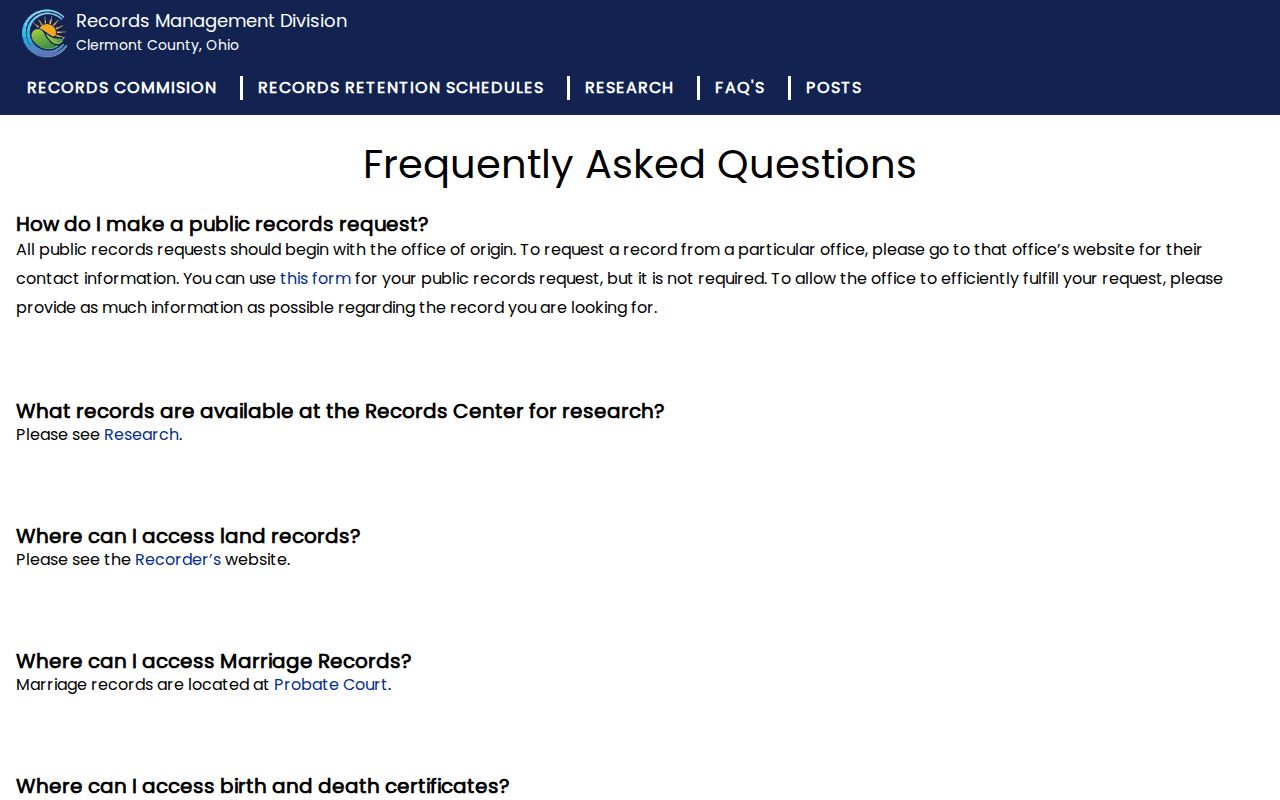
Clermont County Records Management preserves a large county collection, including 10,000 paper boxes, 6,500 historical journals and plat books, and nearly half a million electronic records. It serves more than 40 county offices, but its guidance directs a requester to the office of origin because that office retains authority. For land, that means the Recorder. Marriage, estate, and will questions belong with Probate; birth and death custody depends on the record date.
Records Management guidance sets out the office-of-origin rule for county records.