
Miami Township Resident Lookup Records
A one-person search works best when each source answers a limited question. The Clermont Auditor can connect a name to a tax-roll owner and parcel. The Ohio voter screen can corroborate an individual public registration. Courts and Probate preserve dated case and family-event trails, while state business and license records can confirm a claimed affiliation or credential. Treat each result as a lead to compare, not a complete biography or proof that someone currently lives at an address.
| Record | Confirmation available | Where held | Access boundary |
|---|---|---|---|
| Auditor parcel roll | Owner tied to a parcel, plus situs and mailing fields | Clermont County Auditor | Owner is not necessarily the current occupant |
| Recorder index | Party role, document type, recording date, and instrument trail | Clermont County Recorder | Web documents cover 1980-present; older work moves to the office |
| Individual voter lookup | Public registration and precinct or polling details shown live | Ohio Secretary of State | First name, last name, and county are required; confidential voters are absent |
| Court docket | Party in a filed case and procedural dates | Clermont Clerk Case Access | Restricted, sealed, and pre-1988 material follow separate access rules |
| Probate marriage record | Names as licensed and marriage date | Clermont Probate Court | Public record, with a defined certified-copy route |
| Business or credential record | Entity affiliation or license status | Ohio Secretary of State or eLicense | Filing or credential information is not a home-address confirmation |
Begin with the source that matches the fact already known. An address and possible owner point to the Auditor. A full name and county point to the individual voter tool. A date, court matter, or family event belongs with the Clerk or Probate. Record the source date and the exact field that matched before moving to another system.
Separate Same Names in Miami Township
A matching surname alone is weak evidence. Normalize the person’s first name, former names, initials, and sensible partial spellings, then seek two independent points that fit together. A middle initial, a known prior address, a spouse or event date, a legal description on a deed, or a business name can distinguish similarly named people. Conflicting addresses deserve a note, not an assumption that either address is current.
The Auditor is useful only when the person may own property. Its owner-name and situs-address paths can return a parcel number, legal description, owner mailing address, valuation facts, and transfer reference. The mailing address is where tax correspondence goes. It can be different from the physical, or situs, address and does not establish occupancy. For a broader address-based record chain, use the Miami Township street directory after the one-person identity question is settled.
If an official search has no result, a focused request to the office of origin remains the proper Ohio Public Records Act fallback.
Identity check. Match two independent facts before treating separate public entries as one person, especially when a common name appears in more than one Clermont record.
Miami Township Voter Lookup Fields
Ohio’s public voter search is an individual lookup, not a resident roster. Enter the official fields exactly: First Name, Last Name, and County, selecting Clermont County for Miami Township. After a broad result, the screen can offer a street-name choice to narrow the match. The official tips also suggest trying a first-name derivative or former last name before treating a missed result as final.
| Required search fields | First Name, Last Name, County |
|---|---|
| Conditional narrowing | Street Name after a broad result |
| Useful fallback | Clermont County Board of Elections for registration questions, corrections, or procedure |
| Do not infer | Ballot choices, complete household membership, or details not displayed by the live record |
An absence can have many explanations, including a spelling variation, a move, a timing issue, an inactive or cancelled registration, a data error, or protected status. Ohio does not normally register voters by party. Election participation, when published, concerns whether a ballot was cast and does not reveal selections.
Recorder Roles in a Resident Lookup
Recorder CountyFusion is stronger when a name is tied to property. Search broadly with the Recorder’s partial-name guidance, then use party role and chronology to separate people. A grantee receives an interest in a recorded document. A grantor transfers one. Document type, recording date, instrument number, book or page, and the parcel legal description are the checks that make a surname hit meaningful.
Clermont’s web-copy period begins in 1980. A gap before that date does not end the search. It changes the route to Recorder staff, historical books, counter copies, or a mail request. A recorded role verifies participation in that document, not present residence. Compare the legal description or lot with the Auditor record before concluding that two documents concern the same property.
Court Dockets for a Resident Lookup
Clermont Common Pleas Case Access offers public Common Pleas and Domestic Relations gateways, with party-name and case-number paths and live filters that may change. It is a useful place to verify a precise name against a filed matter, but the Clerk states that Common Pleas records before January 1, 1988 are at the Clerk’s office. The public systems also do not contain civil domestic-violence petitions. Those boundaries should remain in place.
The official Clermont Case Access gateway shows the court’s public search routes and their restrictions.
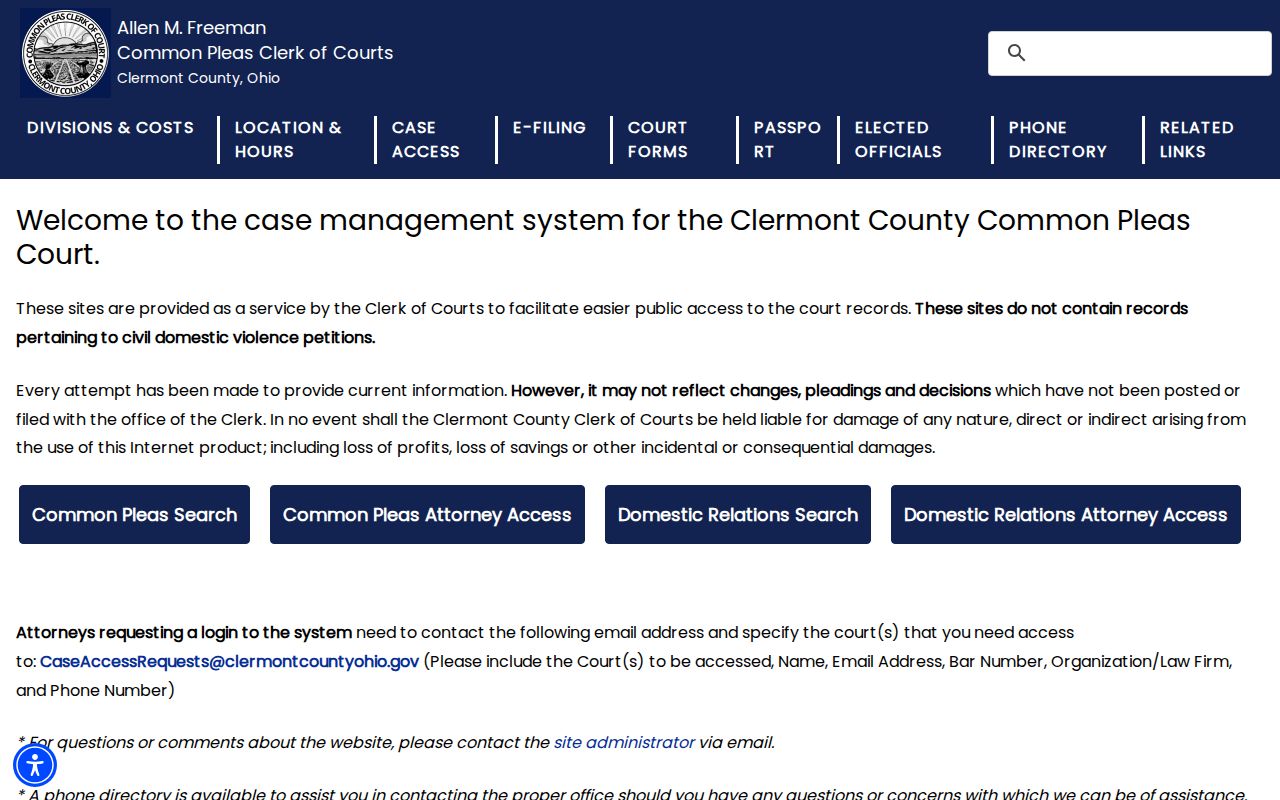
Use the gateway to find a public docket lead, then verify the actual case file or Clerk procedure when a record is older, incomplete online, or restricted.
| Docket item | What to record from a lawful public result |
|---|---|
| Case identity | Case number, court or division, case type, and caption or party names |
| Party context | Party role only as the current docket displays it |
| Timeline | Filing date, docket-event dates, and published status or disposition |
| Documents | Links shown, or the absence of links, without assuming a pleading is public remotely |
The official Municipal Court eServices portal is the local route for civil and criminal or traffic functions.
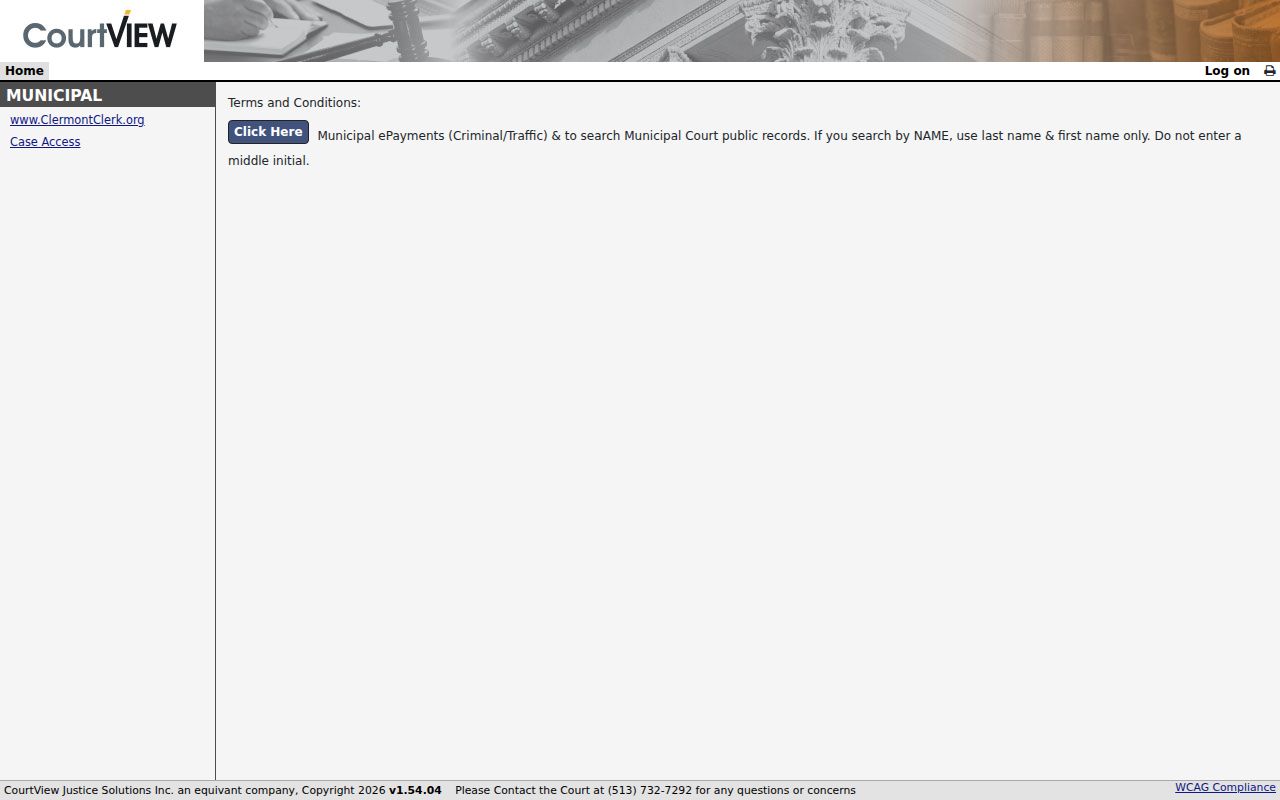
Municipal records before May 1, 1996 require Clerk-office access, and civil domestic-violence petitions are excluded. Juvenile, adoption, sealed, expunged, and protected-personal-identifier material also has separate limits.
Miami Township Probate Record Checks
Probate supplies an important family-event path. Clermont marriage records from 1800 to the present are public, and the court’s certified-copy instruction is unusually specific. A mailed request needs the full names of both applicants as they appeared when the license issued, the month, date, and year of marriage, $3 for each certified copy in cash or money order, and a self-addressed stamped envelope. No identification is required for that public marriage copy.
For birth and death research, Clermont’s custody split is date-based: Probate holds the pre-1908 local route, while Public Health handles post-1908 records with the Ohio Department of Health. Public Health states that it issues statewide Ohio births from 1908 forward and Ohio deaths filed from 1971 to the present. Verify the live form, payment, and processing instructions with the custodian before sending a request.
Business and License Corroboration
Ohio Secretary of State Business Search can corroborate an entity name, status, statutory agent, officer, or filing address when those fields appear in the live result. Ohio eLicense can validate a publicly displayed credential and its status within the relevant board’s record. Both are narrow checks. A business filing address or registered agent is a filing contact, and a credential result confirms neither a person’s current address nor every aspect of identity.
For a property-related business trail, Recorder records can also contain real-estate financing statements, liens, corporate mergers, name changes, or cancellations. Capture the actual document role and date. Do not assume that every trade name belongs in a county Clerk index, because the proper filing custodian can vary.
Verifying a Miami Township Resident
Use a short evidence chain when a name must be checked carefully. Each step narrows the question without turning a public entry into a claim about private household facts.
- Start with the full name and known city, then test spelling variants through the Ohio voter lookup for Clermont County.
- If ownership is plausible, compare an Auditor result’s owner name, situs address, mailing field, parcel number, and legal description.
- Search Recorder parties by name, role, date, and document type, then cross-check the parcel or legal description.
- Use a Clerk, Probate, business, or license source only for the limited dated fact it publishes; request a certified record from its custodian when needed.
- Docket
- A court’s dated list of filings, hearings, and actions in one case.
- Index and image
- An index lists identifying details for a record; an image is the scanned document itself, when access rules permit it.
- Certified copy
- A custodian-issued copy carrying the court or office’s certification for the record requested.
Miami Township Resident Lookup Limits
Ohio Public Records Act, R.C. 149.43, opens nonexempt records held by public offices, but it also incorporates statutory and federal confidentiality rules. The Recorder cannot generally alter, redact, or delete a recorded document without legal authority. A disputed parcel, ownership entry, court item, or recorded instrument belongs with the office that keeps it. An office may also lack a requested record, have disposed of it under a retention schedule, or need time for retrieval and redaction.
Safe at Home protects qualifying Ohio participants facing specified safety risks. R.C. 111.42 governs eligibility, and R.C. 111.43 requires use of a Secretary-designated address in covered dealings and permits a confidentiality notice for later-acquired real estate. Confidential voter records are not public. The program is not a preference-based removal tool, and no search should try to work around it.
Lawful use. A Miami Township resident lookup is for personal, family-history, civic, or property-curiosity research. Do not use public records to stalk, menace, harass, or harm anyone; Ohio statutes R.C. 2903.211 and R.C. 2917.21 can apply even when a source was public.